Newsletter to Members

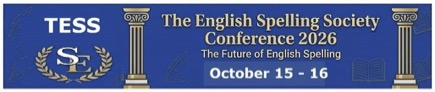
Conference – ‘The Future of English Spelling’


Minutes of AGM

Together with this newsletter you will find copies of the Society’s AGM held on April  25th 2026.

Autumn Conference

 As previously advised, an important conference has been arranged for October 15th and 16th 2026.

This event, which will be open to all members of the Society as well as non-members interested in spelling reform, is entitled ‘the Future or English Spelling.’ The purpose is to consider what has been achieved and not yet achieved in the field of spelling reform, what options are open to the Society and how it may productively pursue its objectives in the years to come. It is set against the outcome of the International English Spelling Congress (2005), which was intended to find agreement on a preferred alternative to current spelling, but whose results have been mixed. It also takes into account the current social and political climate against which those seeking to promote any kind of reform must operate.

The event will cover two days. The first on Thursday15th October will be video only. It is intended to be a relatively informal event allowing Society members and others interested in spelling matters to submit their ideas and proposals. Participants will be free to submit papers, video clips etc, take part in the discussions and participate in break-out sessions. Subject to the need to impose time limits on some presentations, members will be free to present any matter they wish to bring to the attention of the Conference as long as it is related to the problems of English spelling.

The second half of the conference on Friday 16th will be a hybrid event. The physical meeting will take place at Friends House, Euston, London. Refreshments will be provided. Those who do not attend in person will be free to participate by video link.

Attendance at the video and physical meetings will be gratis but the number of places for the physical event on the Friday will be limited to 20.

Our principal speaker on the Friday will be Prof Anatoly Liberman, President of the Society and supporter of spelling reform. He is Professor of Germanic Philology at the University of Minnesota.

Other speakers will be announced in due course.

Although the agenda and format for the second day has yet to be finalised, in broad terms the meeting will be asked to consider a number of options for the future policy of the Society. More details about these shortly.

It is not intended that the Conference will take final decisions on the Society’s future policy, but it will provide helpful background for it to take such decisions in ensuing months.

More information will be made available in due course via the Society’s website and other channels.

Those who would like to attend in person or by video link, please send an email about  their interest in the event to enquiries@spellingsociety.org 


Vacancies

Committee

There is a vacancy on the Committee for one member, which can be filled by co-option.   Anyone interested in filling this vacancy please contact me and I can give them some idea of what it entails.

Trustees

There is also a vacancy for a trustee. Essentially the Society’s trustees administer the Society’s portfolio of investments.  The Constitution requires the Committee to appoint three trustees but one of the posts is currently vacant and needs to be filled. This is a responsible role. However, it does not involve a great amount of work, as the trustees only make occasional changes to the portfolio and in any case are considering the appointment of an investment manager who would take day to day decisions on their behalf.

Anyone interested in becoming a trustee please contact me. For tax reasons it is highly desirable that the candidate be resident in the United Kingdom.


Stephen Linstead

August 2026


spelling in the news VIEW ALL
NEW NEWS SYSTEM

The News System is being replaced in the next few days. Check back for the new look and content.

Did You Know:

• Ask your friend what Y-E-S spells. They won't have any difficulty saying yes. Then ask what E-Y-E-S spells. It's easy when it's written down, but surprisingly difficult when it's spoken. See a YouTube video of this.

• Who has not heard i before e, except after c. A University of Warwick statistician put it to the test. He plugged a list of 350,000 English words into a statistical program to see if the math checked out. It didn't.

• When Adam met Eve for the first time, he said Madam, I'm Adam. This is a palindrome — a phrase or sentence in which the letters, words or even lines read the same in either direction. Adam hoped to impress the most beautiful woman in the world, but she more than matched him by replying simply, Eve. Not bad given that writing, and therefore palindromes, and English ones in particular, had not yet been invented! More palindromes, and a wonderful palindromic poem.

• How would you pronounce ghoti? Pronounce it like this:

and you get ... fish! Thanks to Charles Ollier for writing this in 1855 — and for showing that English spelling has been ludicrous for quite some time.

• One of the arguments in favour of keeping English spelling unchanged is to show the etymology of words. For example, the silent s in island shows the link to the Latin insula. But island actually derives from the Old English íglund, not from the Latin at all. More examples at Mental Floss.


Page editor: N Paterson. Contact by email or form.
FAMOUS ONES WHO WANTED TO IMPROVE
THE ENGLISH SPELLING SYSTEM

​Spelling reform is not a new idea!

Benjamin Franklin "The same is to be observed in all the letters, vowels, and consonants, that wherever they are met with, or in whatever company, their sound is always the same. It is also intended that there be no superfluous letters used in spelling, i.e. no letter that is not sounded [...]"  Franklin proposed a spelling scheme with 6 new letters. (Franklin 1806 p359)

Theodore Roosevelt "It is merely an attempt [...] to make our spelling a little less foolish and fantastic." Theodore Roosevelt promoted the Simplified Spelling Board's gradual reform (see Twain below). (Roosevelt 1906, p3)

Mark Twain "It is my belief that an effort at a slow and gradual change is not worth while. [...] It is the sudden changes [...] that have the best chance of winning in our day. Can we expect a sudden change in our spelling? I think not. But I wish I could see it tried. [...] By a sudden and comprehensive rush the present spelling could be entirely changed and the substitute spelling be accepted, all in the space of a couple of years; and preferred in another couple. But it won't happen, and I am as sorry as a dog." (Twain 1997, pp208-212)

Page editor: N Paterson. Contact by email or form.